 EN
EN
 ko
ko  vi
vi  ru
ru  tr
tr  fr
fr  es
es  it
it  kk
kk  id
id 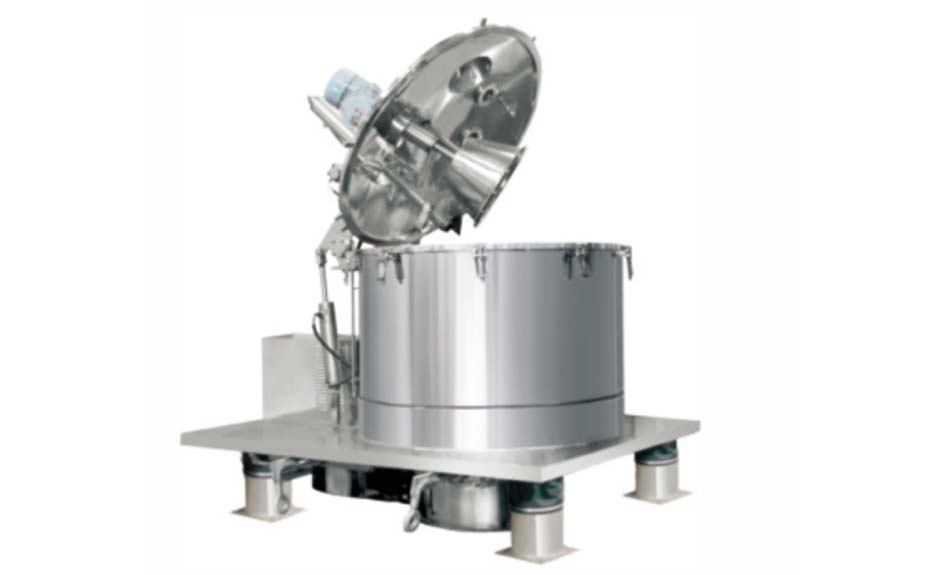
Tel:
0086-523-848088860086-18861028088


Choosing an agitated nutsche filter dryer vs centrifuge is mainly a process-design decision. Both can separate solids from liquids in pharmaceutical and API production, but they handle filtration, cake washing, drying, discharge and containment very differently.
An agitated nutsche filter dryer combines several batch operations inside one closed vessel, while a pharmaceutical centrifuge uses rotational force to accelerate filtration or sedimentation and is often selected where faster mechanical separation or higher throughput is required.
The correct choice depends on particle behavior, solvent handling, required cake washing, final moisture, containment level, batch size and downstream process design.
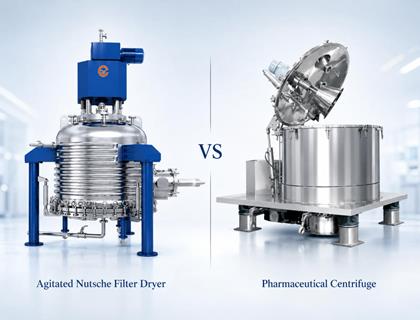
The main difference between an ANFD and a centrifuge is that an ANFD integrates filtration, washing and drying in one enclosed vessel, while a centrifuge primarily provides high-speed solid-liquid separation.
| Factor | Agitated Nutsche Filter Dryer | Centrifuge |
|---|---|---|
| Main driving force | Pressure / vacuum filtration | Centrifugal force |
| Operation | Batch | Batch or continuous |
| Cake washing | Highly controllable | Available, machine-dependent |
| Drying | Integrated in same vessel | Usually separate |
| Containment | Excellent closed processing | High with suitable enclosure |
| Throughput | Moderate | Often higher |
| Best suited for | High-value APIs, toxic/solvent products | Fast separation, larger production rates |
The comparison is therefore not simply about separation efficiency. In pharmaceutical manufacturing, minimizing open product transfers can be just as important as maximizing throughput.
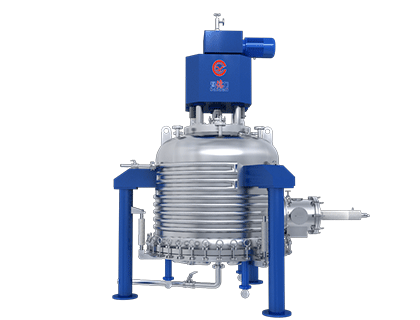
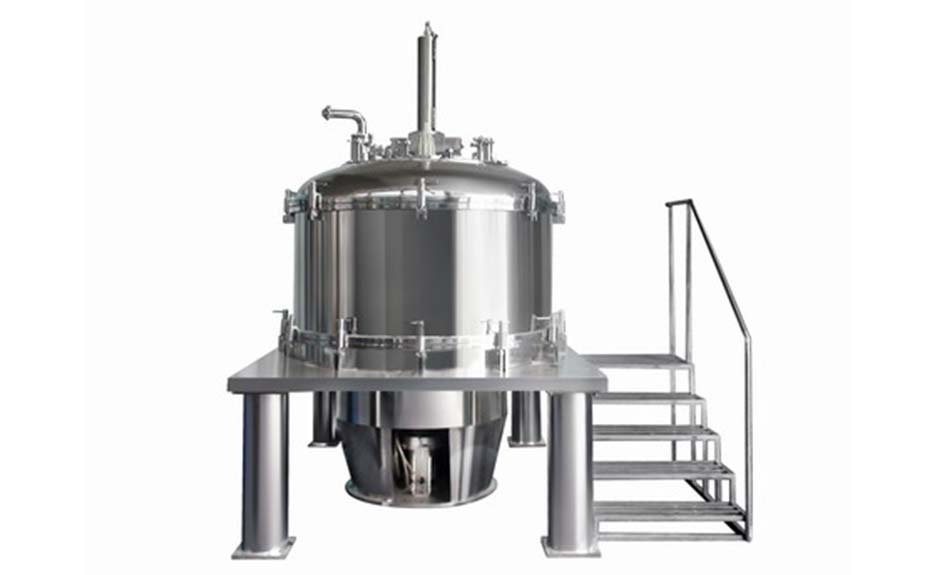
An agitated nutsche filter dryer separates slurry through a filter medium, then allows cake washing, reslurrying, squeezing and drying to occur in the same enclosed vessel.
The slurry enters a sealed vessel above a perforated filter plate. Pressure or vacuum drives the liquid through the filter medium while solids remain as a cake.
An agitator can then move vertically and rotate in different directions. It may smooth or compress the cake during filtration, break it into smaller particles, reslurry the solids with washing liquid and later assist with drying and discharge.
Saideli's published nutsche filter working principle describes filtration followed by heating, agitation and product discharge within the same equipment. This integrated approach reduces the need to move a wet cake between separate filtration and drying machines.
The closed configuration can be especially useful when handling potent APIs, toxic compounds or valuable solvents where exposure and product loss need to be controlled.
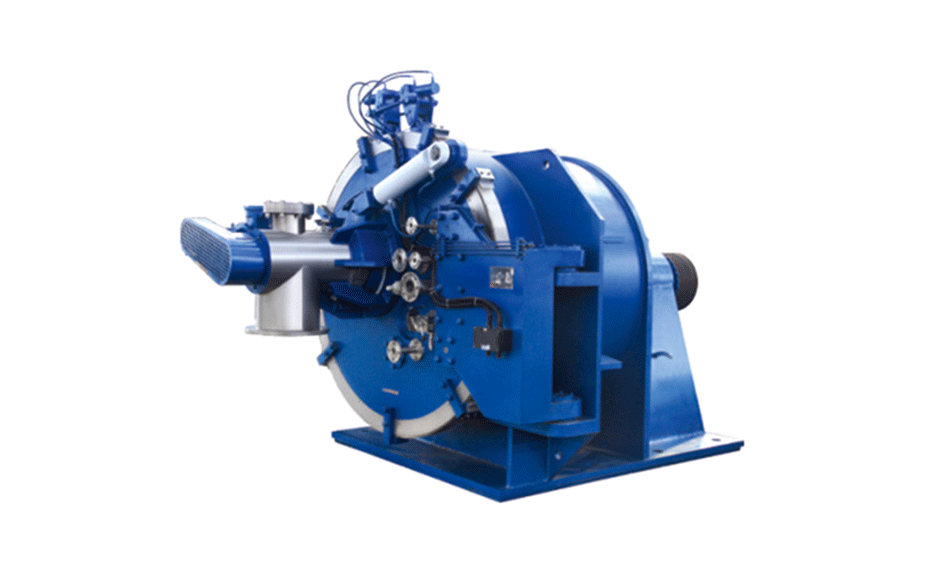
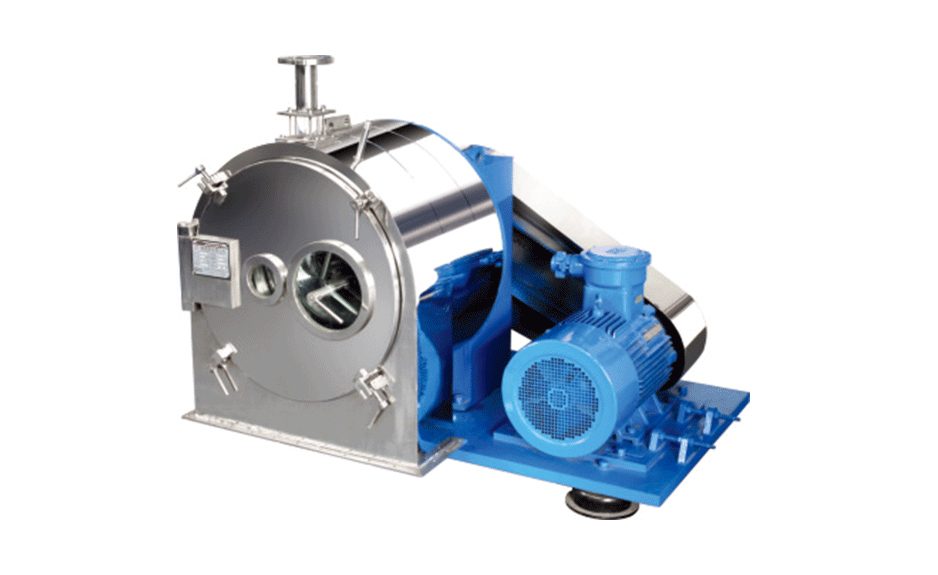
A centrifuge separates solids and liquid by rotating the suspension at high speed so centrifugal force accelerates filtration or density-based separation.
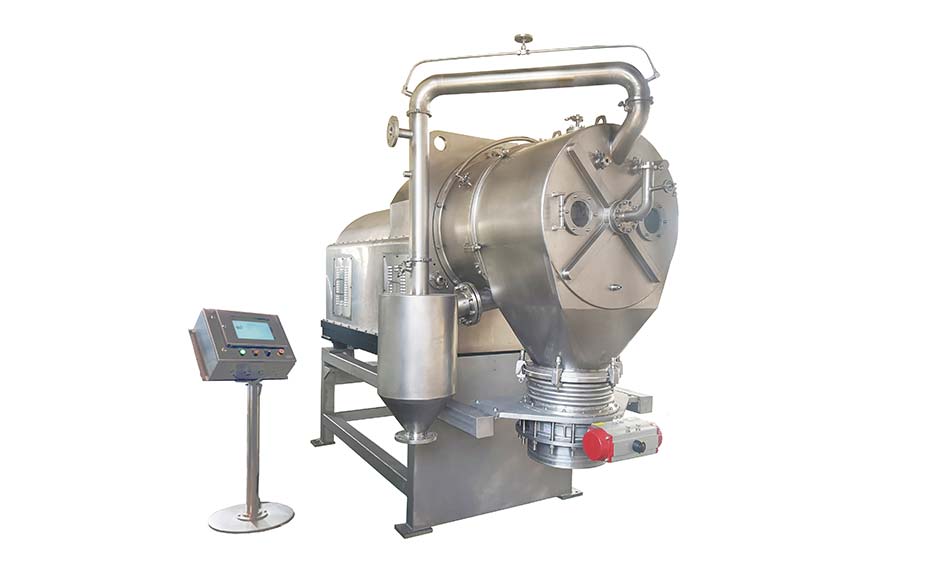
In a filtering industrial centrifuge, liquid passes through a filter medium while solids remain inside the basket. Depending on the machine, the cake may then be washed, spun to lower moisture and removed by scraper, bag lifting or another discharge mechanism.
Saideli's centrifuge machine in pharmaceutical industry guidance notes that centrifuges are used for API separation, purification and other pharmaceutical processes where efficient separation and controlled operation are required.
Pharmaceutical centrifuges can also use sealed housings and automated cleaning arrangements. This matters because API equipment must be designed for suitable cleaning and contamination control. The FDA's ICH Q7 GMP guidance for APIs states that equipment should be appropriately designed, adequately sized and suitable for cleaning, maintenance and its intended use.
The most important differences between ANFDs and centrifuges are process integration, throughput, cake handling, drying capability and containment strategy.
An ANFD keeps filtration, washing and drying in one vessel. This can reduce product transfers and operator exposure, which is valuable for potent or solvent-rich pharmaceutical products.
A centrifuge usually separates faster because centrifugal force produces a much stronger driving force than gravity or moderate pressure filtration. It may therefore be better for larger batches or applications where throughput is the dominant requirement.
ANFDs also offer flexible cake washing because the agitator can reslurry the cake and expose particles repeatedly to wash liquid. A centrifuge can wash cake effectively, but the wash step is usually integrated into the separation cycle rather than combined with full agitation and in-vessel drying.
Equipment size is another practical consideration. Saideli's agitated nutsche filter dryer sizes range from models with approximately 0.38 m² to 5.3 m² filtration area, with listed internal diameters from 700 to 2600 mm.
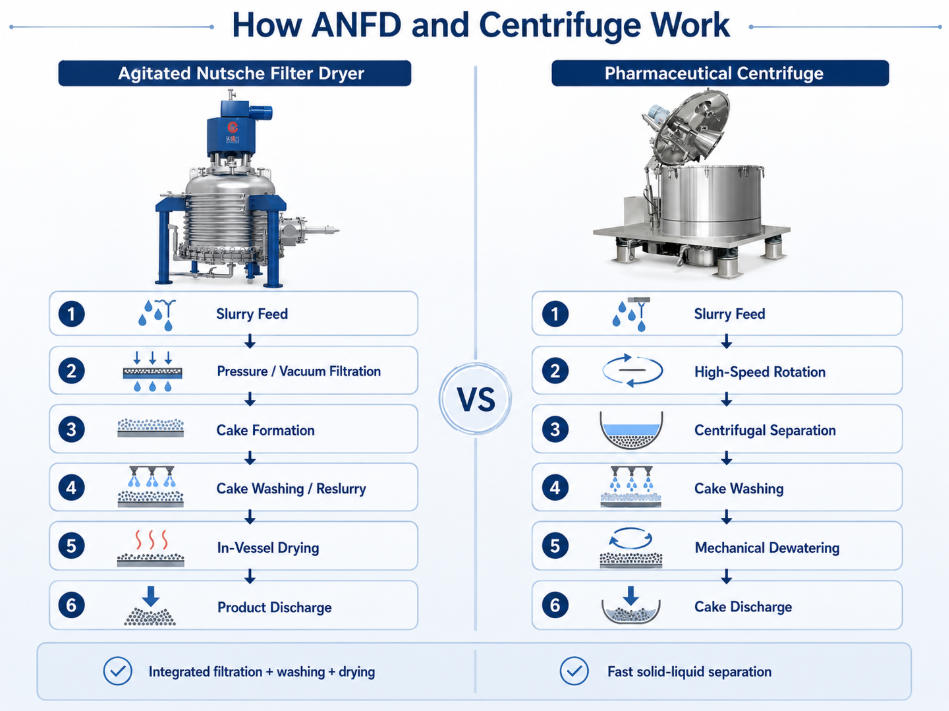
ANFDs are generally stronger where containment and integrated washing/drying are priorities, while centrifuges are often stronger where fast separation and higher throughput matter most.
An ANFD is often preferred for high-value APIs, potent compounds, toxic materials and solvent-based products where reducing open transfers is important. It can also be useful where cake washing needs repeated reslurrying before final drying.
A centrifuge may be more suitable when the process has a free-filtering crystalline product, larger batch volume or strict production-rate requirements. Modern pharmaceutical centrifuges can also provide enclosed operation, automated cycles and cleanable product-contact areas.
When reviewing industrial centrifuge options, machine type should be matched to particle size, filtration behavior and discharge requirement rather than assuming that every centrifuge provides the same performance.
For multiproduct API facilities, cleaning strategy also matters. FDA guidance notes that nondedicated equipment should be cleaned between different products to prevent cross-contamination, and cleaning procedures should be reproducible and documented.
The correct equipment should be selected from the complete process requirement rather than from separation speed alone.
Before deciding, evaluate:
Particle size and filtration rate: easily filtered crystals often suit centrifuges; slower-filtering cakes may benefit from controlled ANFD processing.
Required cake washing: repeated reslurry washing favors an ANFD.
Final moisture: an ANFD can integrate drying; centrifuge cake may require a separate dryer.
Containment: potent APIs or toxic solvents may favor fewer product transfers.
Throughput: centrifuges are often more attractive for high production rates.
Cleaning and changeover: multiproduct facilities need accessible or validated cleaning systems.
Saideli manufactures both filtration/drying systems and pharmaceutical centrifuges, so the equipment-selection question can be approached from the actual API process rather than from one machine category.
Pilot testing is especially useful when filtration rate, crystal breakage, cake compressibility or solvent removal are difficult to predict from laboratory data alone.
The agitated nutsche filter dryer vs centrifuge decision depends on what happens before and after solid-liquid separation.
An agitated nutsche filter dryer is particularly attractive when filtration, repeated washing, drying and containment need to occur in one closed vessel. A pharmaceutical centrifuge is often preferable when rapid separation, high throughput and efficient mechanical dewatering are the main priorities.
For API production, the best choice should balance separation performance with containment, cleaning, product handling and downstream processing requirements.
An ANFD combines filtration, washing and drying, while a centrifuge mainly uses centrifugal force for rapid solid-liquid separation.
Yes. Heating, vacuum and agitation can allow drying inside the same vessel.
Yes. Many filtering centrifuges include cake-washing stages during the operating cycle.
Both can be enclosed, but ANFDs reduce transfers by combining several process stages in one vessel.
A centrifuge is often better where fast separation and larger production capacity are required.
Provide slurry composition, particle size, solids concentration, filtration behavior, washing requirements, target moisture, solvents and batch capacity.