 EN
EN
 ko
ko  vi
vi  ru
ru  tr
tr  fr
fr  es
es  it
it  kk
kk  id
id 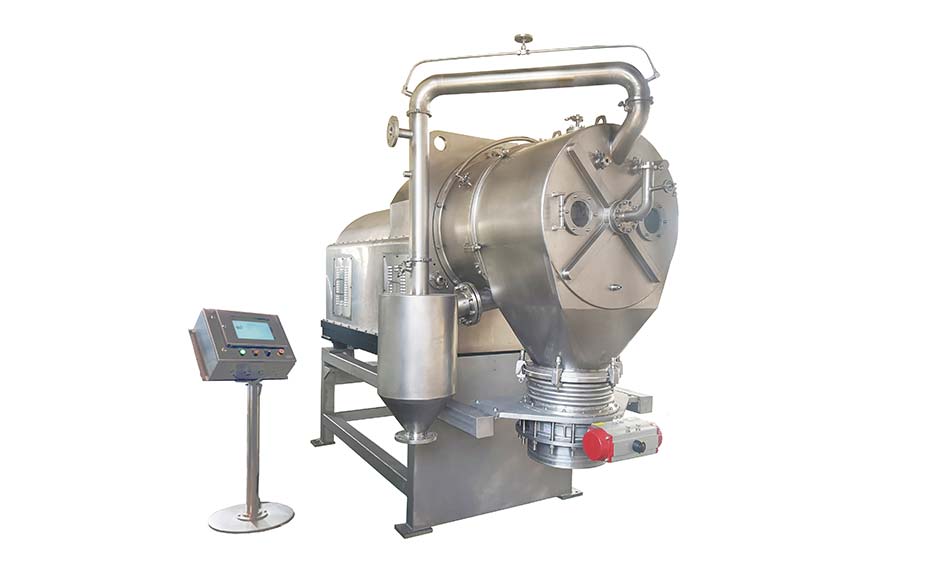
Tel:
0086-523-848088860086-18861028088


In modern chemical, pharmaceutical, food, environmental, and new energy production, centrifuges are essential separation machines for handling suspensions, slurries, crystals, wet solids, and mixed liquid phases. A centrifuge uses high-speed rotation to separate materials by density, particle size, and phase difference, making it much faster than natural settling or gravity filtration.
For industrial buyers, understanding what a centrifuge is, how it works, and which type fits your process is the first step before comparing models, capacity, automation level, and cost. Whether you are selecting an industrial centrifuge machine for chemical crystal separation, a pharmaceutical centrifuge for API production, or a solid liquid separation centrifuge for continuous processing, the right equipment can directly affect product purity, final moisture, production efficiency, and operating safety.
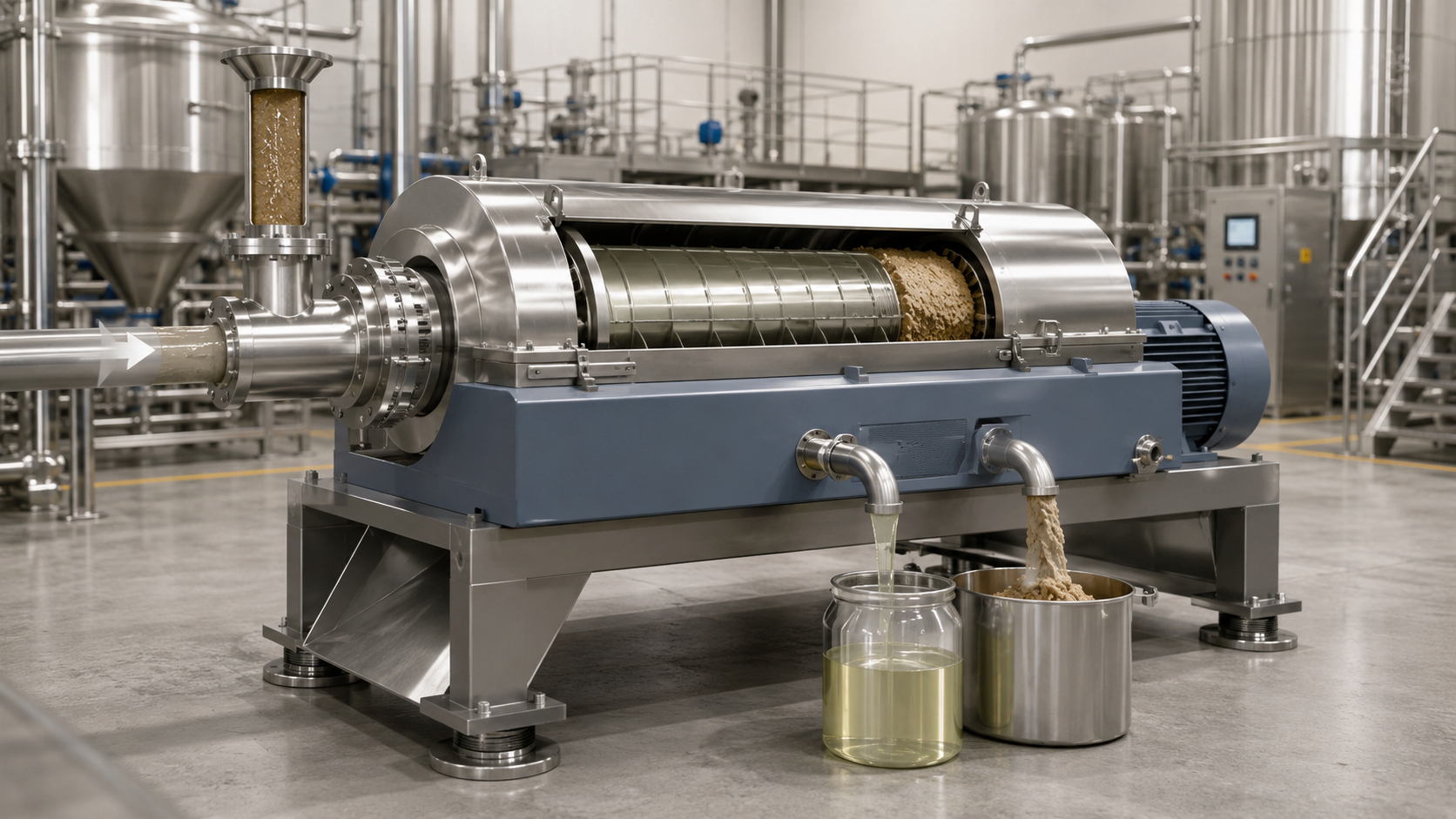
A centrifuge is a mechanical separation machine that rotates at high speed to generate centrifugal force. This force pushes heavier particles or denser phases outward, while lighter liquids or phases remain closer to the center or are discharged through another outlet.
In simple terms, a centrifuge helps separate mixtures that are difficult to separate by gravity alone. If a solid-liquid mixture settles too slowly, a centrifuge accelerates the process by applying force many times stronger than gravity.
Centrifuges are commonly used to separate:
· Crystals from mother liquor
· Fine solids from liquid suspension
· Wet solids from process liquid
· Sludge from wastewater
· Oil-water mixtures
· Pharmaceutical intermediates
· Food and fermentation materials
· Chemical and mineral slurries
In industrial production, a centrifuge is usually part of a complete separation system, working together with reactors, crystallizers, filters, dryers, conveyors, tanks, and packaging equipment.
The basic centrifuge working principle is based on centrifugal force. When the bowl, basket, drum, or rotor rotates at high speed, the material inside is forced outward. Heavier solids move toward the outer wall, while liquid passes through a filter medium, flows through discharge channels, or remains in a separate liquid layer.
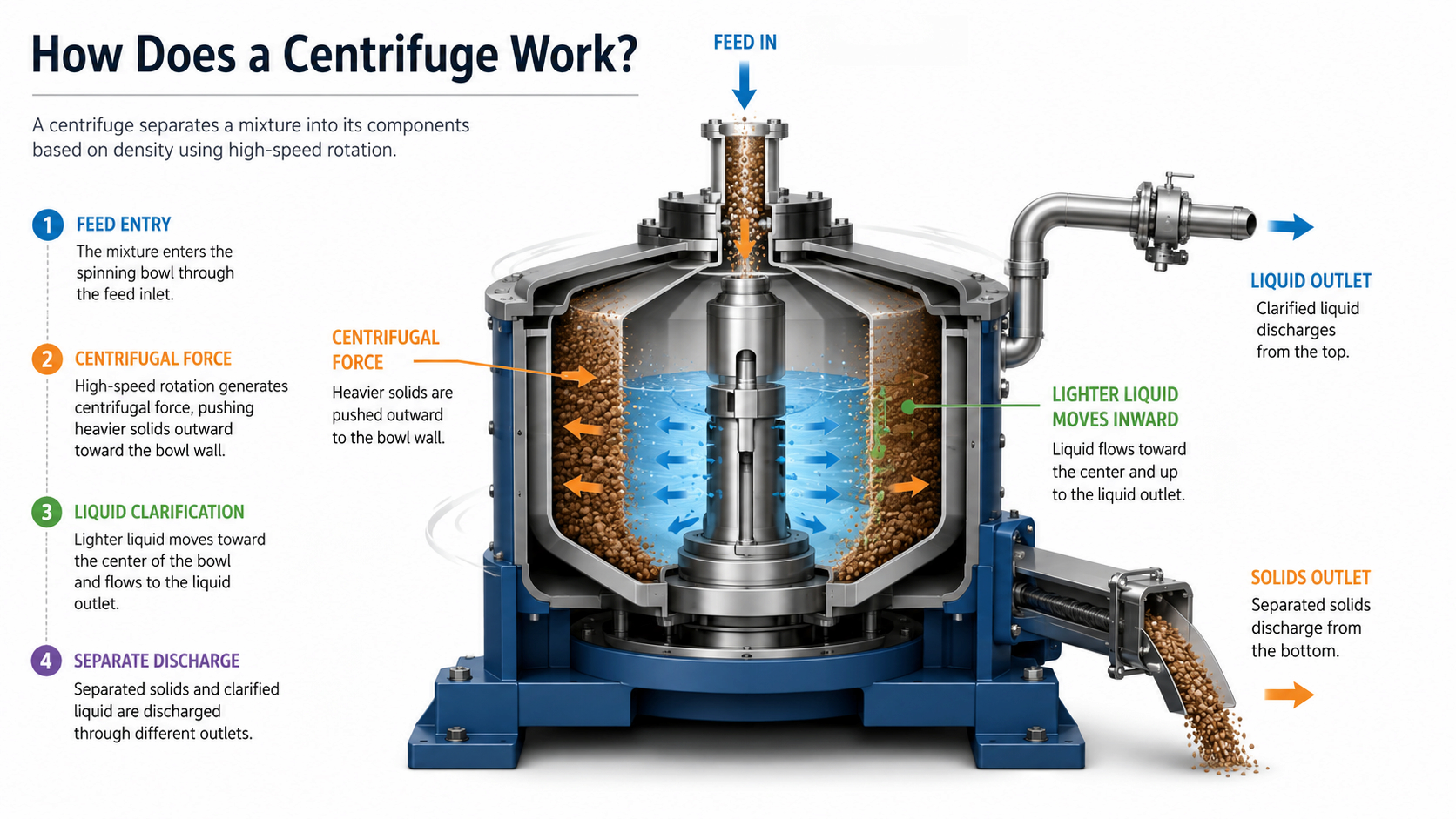
Feeding
The slurry, suspension, emulsion, or wet material enters the centrifuge through a feed pipe.
Acceleration
The material is accelerated to the rotational speed of the bowl, basket, or drum.
Separation
Denser solids move outward. Liquids pass through the filter medium or are discharged through liquid outlets.
Washing or Dewatering
Some centrifuges allow cake washing inside the machine to remove impurities or mother liquor.
Discharge
Solids and liquids are discharged separately, either continuously or batch by batch.
Industrial centrifuges are widely used because they provide stable and efficient separation in large-scale production.
Key advantages include:
· Faster separation than gravity settling
· Lower final moisture for wet solids
· Better solid recovery
· More consistent product quality
· Suitable for continuous or batch production
· Reduced manual handling
· Compatible with washing, filtration, clarification, and dewatering
· Can be customized for corrosion resistance, explosion-proof operation, and sanitary design
For buyers handling large production volumes, selecting the right industrial centrifuge machine helps improve separation efficiency while reducing downstream drying load and operating cost.
Although centrifuges are powerful separation machines, they are not suitable for every material or process.
Common limitations include:
· Higher initial investment than simple filtration equipment
· Need for proper installation and foundation support
· Sensitivity to feed concentration and particle size changes
· Possible crystal breakage if the discharge method is too aggressive
· Regular maintenance required for bearings, seals, filter cloth, and rotating parts
· Safety requirements due to high-speed rotation
For this reason, material testing and technical evaluation are important before choosing a centrifuge model.
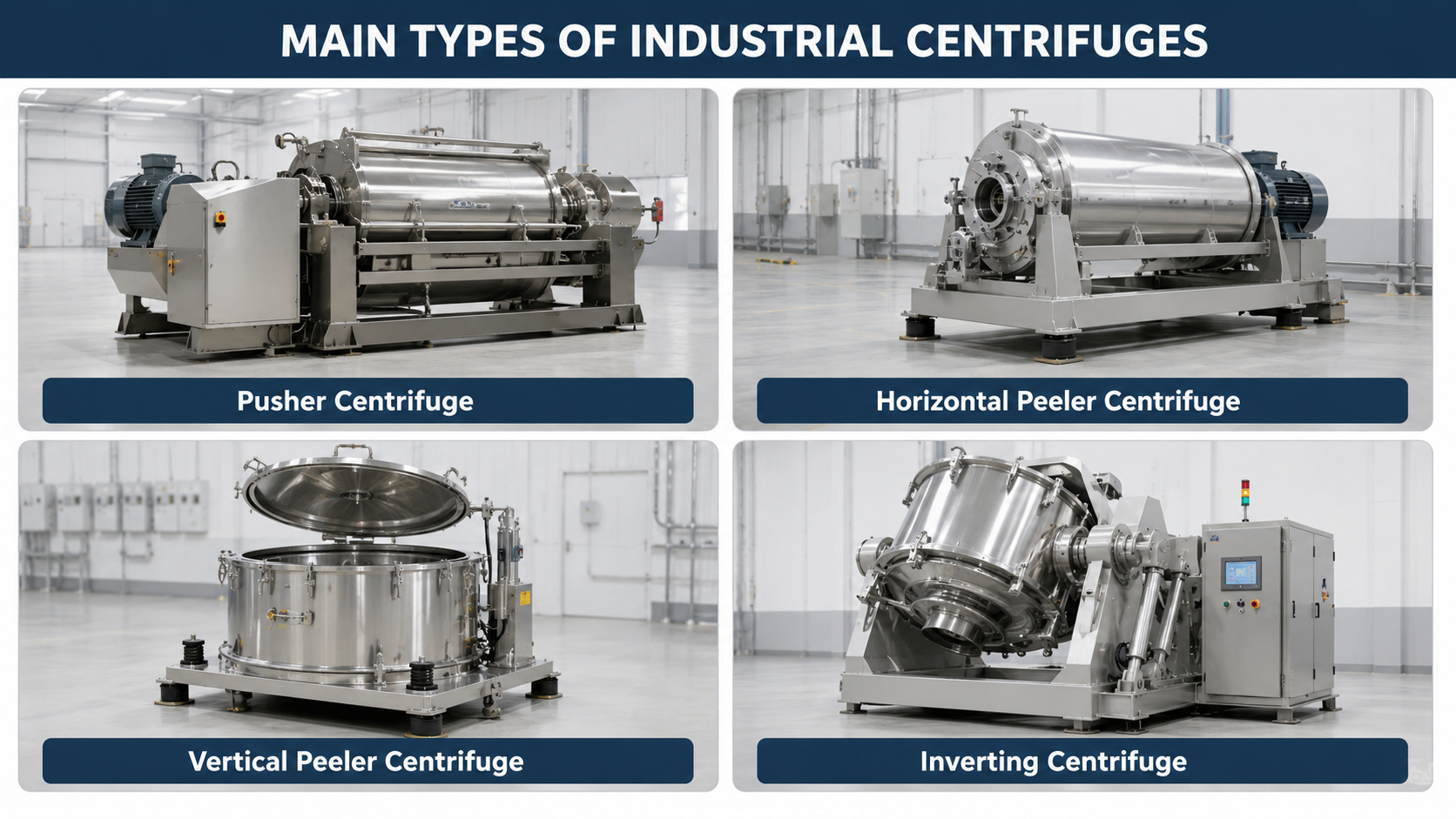
Different centrifuge types are designed for different materials, particle sizes, production methods, and discharge requirements.
Centrifuge Type | Suitable Materials | Operation Mode | Main Advantage |
Pusher centrifuge | Coarse crystals, high solid content slurry | Continuous | High capacity and continuous discharge |
Horizontal peeler centrifuge | Fine chemicals, pharmaceutical intermediates | Batch automatic | Good cake washing and scraper discharge |
Vertical peeler centrifuge | Medium particle suspension | Batch automatic | Compact structure and flexible operation |
Inverting centrifuge | High-cleanliness products | Batch automatic | Low residue and gentle discharge |
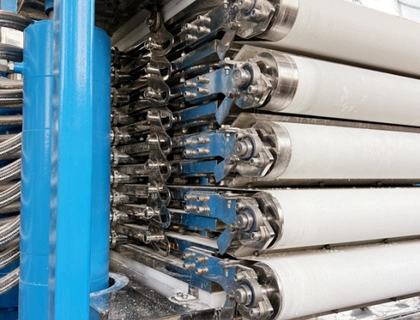
Basket centrifuge | General solid-liquid separation | Batch | Simple structure and broad use |
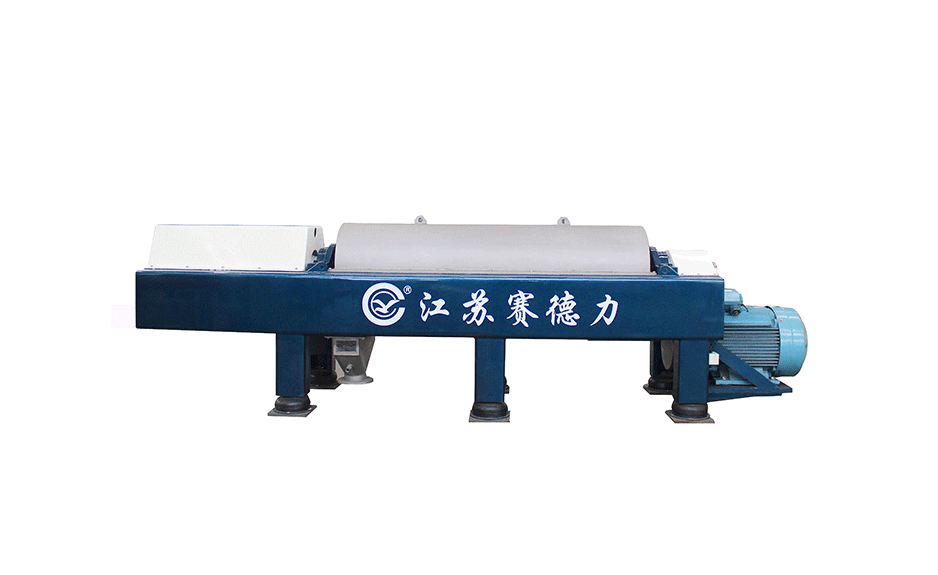
Decanter centrifuge | Sludge, high-volume slurry | Continuous | Continuous sedimentation separation |
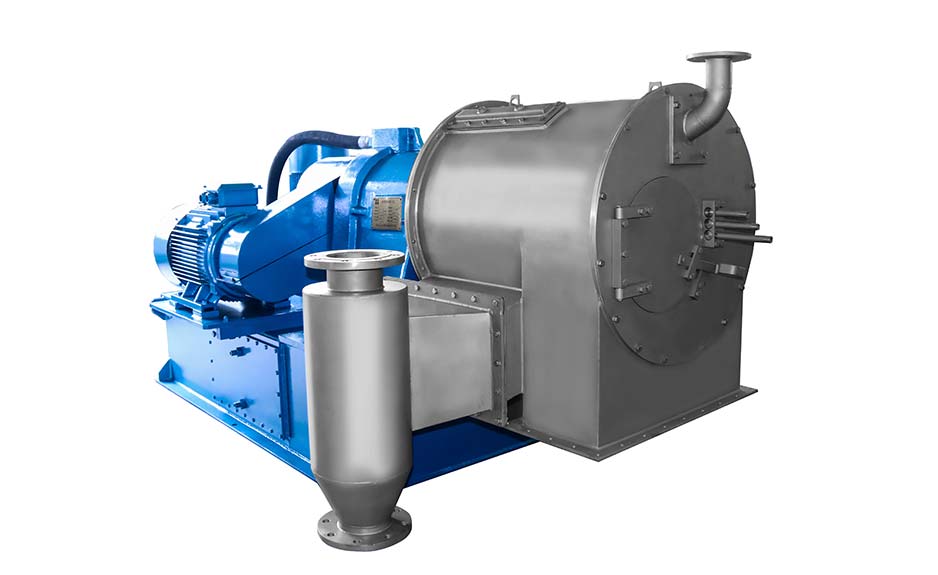
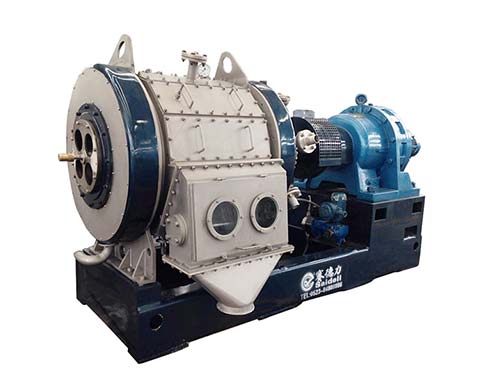
A pusher centrifuge machine is suitable for continuous separation of materials with relatively coarse particles and high solid concentration. During operation, solids are retained on the screen while liquid passes through, and the pusher mechanism moves the filter cake forward for continuous discharge.
Pusher centrifuges are commonly used in chemical, salt, fertilizer, food, and pharmaceutical-related production where stable continuous operation is required.
A horizontal peeler centrifuge is suitable for automatic batch separation, cake washing, and scraper discharge. It is often used when product purity, washing performance, and process control are important.
This type is commonly used in fine chemicals, pharmaceutical intermediates, and materials that require controlled filtration and discharge.
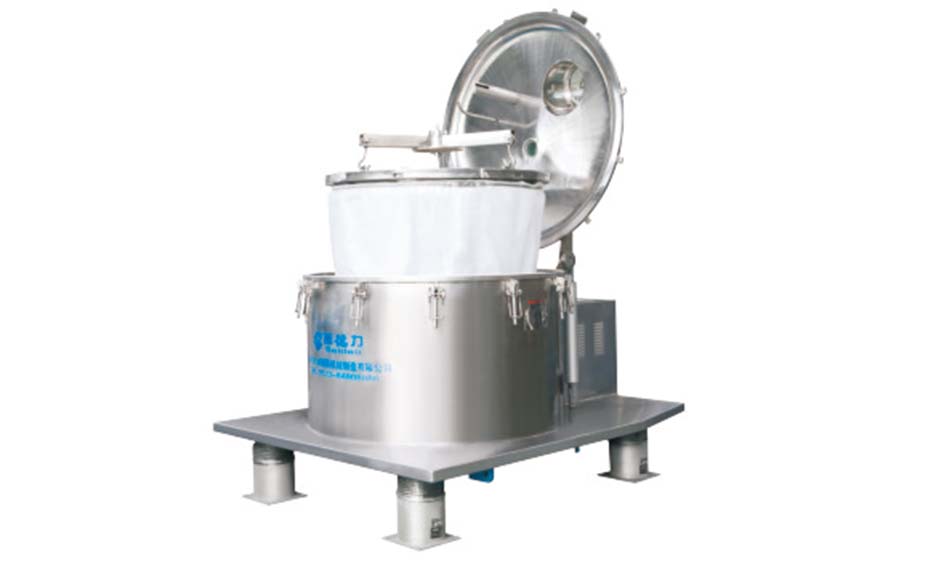
A vertical peeler centrifuge is designed for batch solid-liquid separation with scraper discharge. It is suitable for medium particle suspensions and production lines where compact structure and flexible operation are needed.
Compared with horizontal models, vertical designs may save floor space and provide a practical option for certain chemical and pharmaceutical processes.
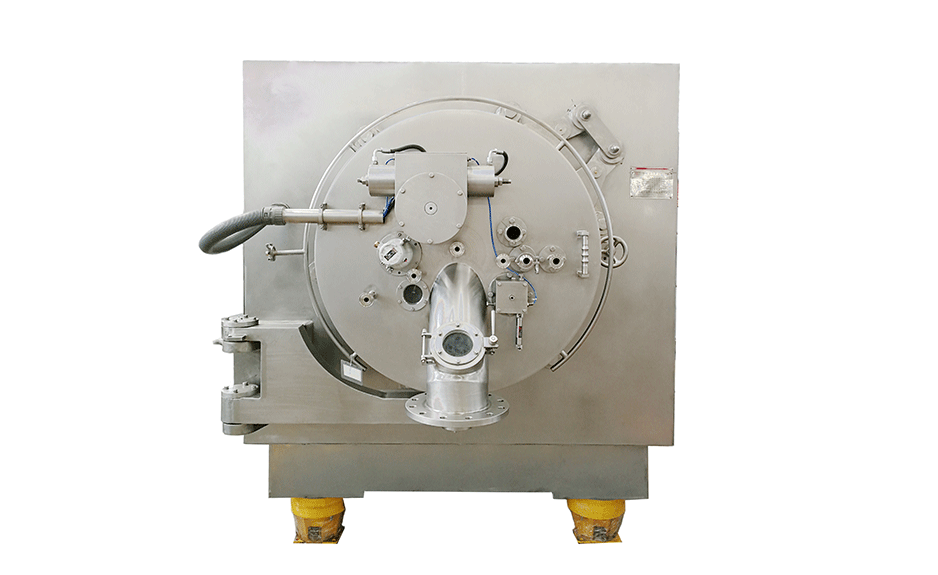
An inverting centrifuge is designed for cleaner discharge and reduced cake residue. The filter cloth can be inverted during discharge, helping remove solids more completely from the machine.
This type is often considered when product recovery, cleanliness, and reduced cross-contamination are important.
Choosing a centrifuge should not be based only on the equipment name. Buyers need to compare separation method, discharge style, particle suitability, washing effect, and production capacity.
For large-volume continuous production, a pusher centrifuge may be more efficient. For pharmaceutical or fine chemical materials that require washing and controlled discharge, a peeler centrifuge may be more suitable. For high-cleanliness production, an inverting centrifuge can help reduce residue and improve discharge completeness.
In chemical production, centrifuges are widely used for separating crystals, salts, intermediates, catalysts, and reaction products. A centrifuge separator machine can help improve product recovery, reduce moisture, and prepare solids for drying or packaging.
A pharmaceutical centrifuge is used for API production, intermediates, crystal separation, and high-purity material processing. Compared with general industrial applications, pharmaceutical production usually requires better sealing, cleaner structure, smoother material contact surfaces, and process validation support.
In food and fermentation industries, centrifuges are used for clarification, dewatering, and separation of biological or organic materials. They can help improve liquid clarity, recover valuable solids, and reduce downstream processing load.
Centrifuges are commonly used for sludge dewatering and wastewater treatment. Decanter centrifuges are especially suitable for high-volume sludge processing because they can continuously separate solids and liquids.
In new energy material production, centrifuges may be used for separating battery materials, fine powders, chemical intermediates, and functional materials. Equipment selection must consider particle size, abrasion, corrosion, and product purity.
industrial centrifuge capacity depends on several process variables:
· Feed volume
· Solid concentration
· Particle size distribution
· Liquid viscosity
· Filtration speed
· Cake thickness
· Washing time
· Required final moisture
· Discharge cycle
· Operation mode
A machine with larger volume does not always mean better performance. If the filtration speed is low or the cake is difficult to discharge, actual capacity may be limited. Therefore, capacity should be evaluated based on material testing and production targets.
industrial centrifuge price is affected by machine type, size, material grade, automation level, sealing design, explosion-proof requirements, corrosion resistance, and customization.
When comparing cost, buyers should not only consider the initial quotation. The total cost should include equipment price, energy consumption, spare parts, filter cloth or screen replacement, downtime risk, automation level, and long-term separation efficiency.
When selecting an industrial centrifuge machine supplier, buyers should evaluate both equipment capability and engineering support.
Important points include:
· Experience with similar materials
· Ability to provide model selection support
· Customization capability
· Material testing support
· Manufacturing quality control
· After-sales service
· Spare parts supply
· Installation and commissioning support
For complex chemical or pharmaceutical applications, supplier experience can be as important as the centrifuge model itself.
The right centrifuge depends on material behavior, process goals, production volume, and industry requirements.
Application Need | Recommended Centrifuge Type | Selection Focus |
Continuous separation of coarse crystals | Pusher centrifuge | High capacity and stable continuous discharge |
Automatic batch separation with cake washing | Horizontal peeler centrifuge | Product purity, washing effect, and scraper discharge |
Compact batch operation | Vertical peeler centrifuge | Space saving and flexible process control |
High-cleanliness discharge | Inverting centrifuge | Low residue and reduced contamination risk |
General batch solid-liquid separation | Basket centrifuge | Simple structure and broad application range |
Sludge or high-volume slurry treatment | Decanter centrifuge | Continuous sedimentation and large throughput |
If the goal is lower final moisture, buyers should focus on filtration area, cake thickness, spin speed, and dewatering time. If the goal is higher product purity, the washing system and discharge control become more important. If the goal is higher capacity, continuous operation and feed stability should be prioritized.
For pharmaceutical and fine chemical production, sealing, cleanability, material contact surface, and automation should also be carefully evaluated. For corrosive or solvent-based materials, stainless steel grade, anti-corrosion design, explosion-proof configuration, and safety protection should be confirmed before purchase.
For most industrial buyers, centrifuge selection should begin with the material, not the machine model. Particle size, crystal strength, solid concentration, liquid viscosity, and target moisture determine whether a pusher, peeler, basket, decanter, or inverting design is more suitable.
If the material has coarse particles and high solid content, continuous operation may be practical. If the product requires washing, purity control, or careful discharge, a peeler or inverting centrifuge may be the better choice. For high-volume slurry or sludge, sedimentation-based equipment may be more suitable than filtration-based equipment.
Because centrifuges operate at high speed, safety and maintenance are critical.
Operators should:
· Balance feed and avoid overload
· Check rotating parts before operation
· Inspect filter cloth, screen, bearings, seals, and discharge devices
· Do not exceed the designed speed
· Keep covers closed during operation
· Stop the machine if abnormal vibration or noise occurs
· Follow scheduled maintenance instructions
A centrifuge is a machine that spins materials at high speed to separate components by density, particle size, or phase difference. In industry, it is commonly used for solid-liquid separation, clarification, dewatering, washing, and product recovery.
A centrifuge works by generating centrifugal force through high-speed rotation. Heavier solids or denser phases move outward, while lighter liquids or phases move inward or discharge through separate outlets.
A centrifuge can separate solids from liquids, liquids from liquids, and particles with different densities. Common examples include crystals from mother liquor, sludge from wastewater, oil from water, and wet solids from process liquid.
A filtration centrifuge uses filter cloth, screen, or a perforated basket to retain solids while liquid passes through. A sedimentation centrifuge separates materials mainly by density difference without relying on a filter medium.
For chemical production, the best centrifuge depends on particle size, solid concentration, corrosion level, washing requirement, and capacity. Pusher centrifuges are suitable for continuous crystal separation, while peeler centrifuges are better for batch washing and controlled discharge.
Pharmaceutical production often uses peeler centrifuges, inverting centrifuges, and other enclosed centrifuge systems because they support cleaner operation, washing, automatic discharge, and better contamination control.
To choose capacity, evaluate feed rate, solid concentration, particle size, filtration speed, cake thickness, washing time, final moisture requirement, and discharge cycle. Material testing is recommended before final model selection.
Price varies because of machine type, size, material grade, automation, sealing structure, explosion-proof design, corrosion resistance, sanitary requirements, and customization level. Buyers should compare total operating cost, not only the initial equipment price.# Markdown syntax guide