 EN
EN
 ko
ko  vi
vi  ru
ru  tr
tr  fr
fr  es
es  it
it  kk
kk  id
id 
Tel:
0086-523-848088860086-18861028088


Choosing a perforated basket centrifuge vs non perforated basket centrifuge begins with one fundamental question: should the liquid pass through a filter medium, or should solids separate by settling against a solid bowl wall?
A perforated basket uses holes in the rotating basket together with filter cloth or screen. Centrifugal force pushes liquid through the cake and filter medium while solids remain inside. A non-perforated basket has a solid wall, so separation relies primarily on density difference and centrifugal sedimentation rather than cake filtration.
This distinction affects particle size, cake washing, liquid clarity, solids recovery and discharge design. Selecting the correct basket centrifuge therefore depends on the physical behavior of the suspension, not simply the required processing capacity.
A perforated basket centrifuge performs centrifugal filtration, while a non-perforated basket centrifuge performs centrifugal sedimentation against a solid wall.
| Factor | Perforated Basket | Non-Perforated Basket |
|---|---|---|
| Basket wall | Perforated | Solid |
| Separation method | Filtration | Sedimentation |
| Filter cloth/screen | Normally required | Not normally required |
| Main requirement | Filterable solids | Density difference |
| Cake formation | On filter medium | Sediment against wall |
| Cake washing | Relatively easy to integrate | More limited |
| Typical objective | Recover/dewater solids | Clarify liquid or concentrate solids |
The broader separation principle is well established. A ScienceDirect reference on centrifugal filtration explains that a rotating perforated basket uses a filter medium while centrifugal force drives liquid through the cake.
By comparison, solid-wall sedimenting centrifuges depend on a density difference between the solid and liquid phases.
Perforated baskets separate by forcing liquid through openings in the rotating wall, whereas non-perforated baskets collect denser solids against an impermeable wall.
In a perforated design, slurry enters the rotating basket and quickly spreads against the wall. Liquid moves outward through the filter cake, filter cloth and basket perforations, while solids accumulate inside as a cake.
As the cake becomes thicker, it becomes part of the filtration system itself. The cake can then be washed and further spun to reduce residual liquid before discharge.
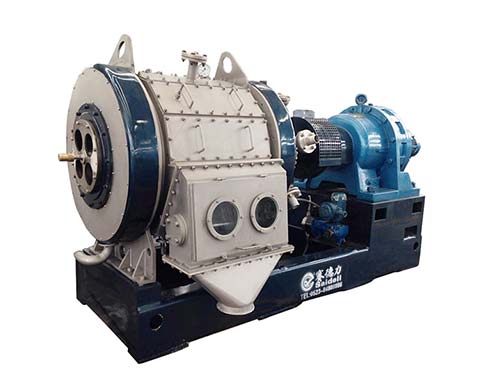
Saideli's explanation of the perforated basket centrifuge describes this basic filtering mechanism, where centrifugal force accelerates solid-liquid separation through a perforated drum.
A non-perforated design has no route for filtrate through the basket wall. Instead, centrifugal acceleration drives heavier particles toward the wall while the clarified liquid remains closer to the rotational axis. The solids remain as sediment until they are removed.
This means a non-perforated basket depends much more strongly on particle settling characteristics and density difference.
The key differences are filtration capability, particle retention, cake formation, washing performance and dependence on density difference.
Perforated baskets are particularly useful when the valuable product is a filterable solid. The filter medium retains particles, allowing a cake to form that can often be washed before final dewatering.
ScienceDirect notes that filtering centrifuges can separate particles even when solid and liquid densities are relatively similar because the filter medium physically retains solids. It also notes that suitable filtration solids generally need adequate particle size and cake permeability.
Non-perforated baskets do not provide this physical barrier. If particles are too small, settle slowly or have density close to the liquid, separation may require longer residence time or greater centrifugal acceleration.
Another difference is liquid handling. In a perforated machine, filtrate exits directly through the basket. In a solid-wall design, clarified liquid typically needs to be decanted or overflowed separately.
For process engineers, the important question is therefore whether the material behaves more like a filterable crystal suspension or a sedimenting slurry.
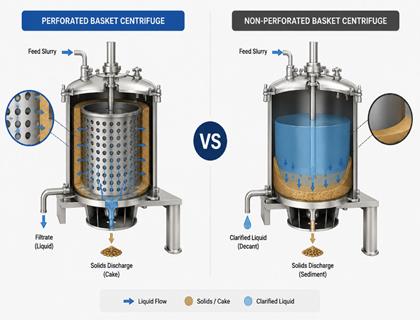
Perforated basket centrifuges suit filterable crystalline and granular solids, while non-perforated designs are better suited to suspensions that separate effectively by density-driven settling.
A perforated design is commonly considered for salts, sugar, starch, chemical crystals, pharmaceutical intermediates and other materials where solids form a permeable cake.
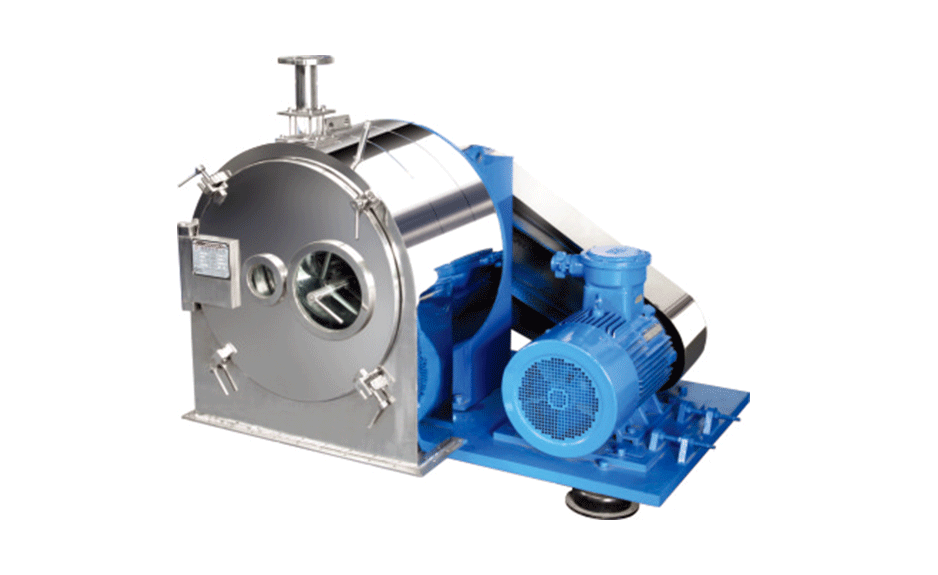
For example, Saideli's GKC perforated horizontal scraper series covers basket diameters from 600 to 1600 mm, loading capacities from 53 to 900 kg, and maximum rotational speeds from 2400 rpm on the smallest model to 950 rpm on the largest.
Non-perforated machines are more appropriate when the objective is clarification or sediment concentration rather than cake filtration. Their performance is influenced by density difference, particle settling velocity, viscosity and residence time.
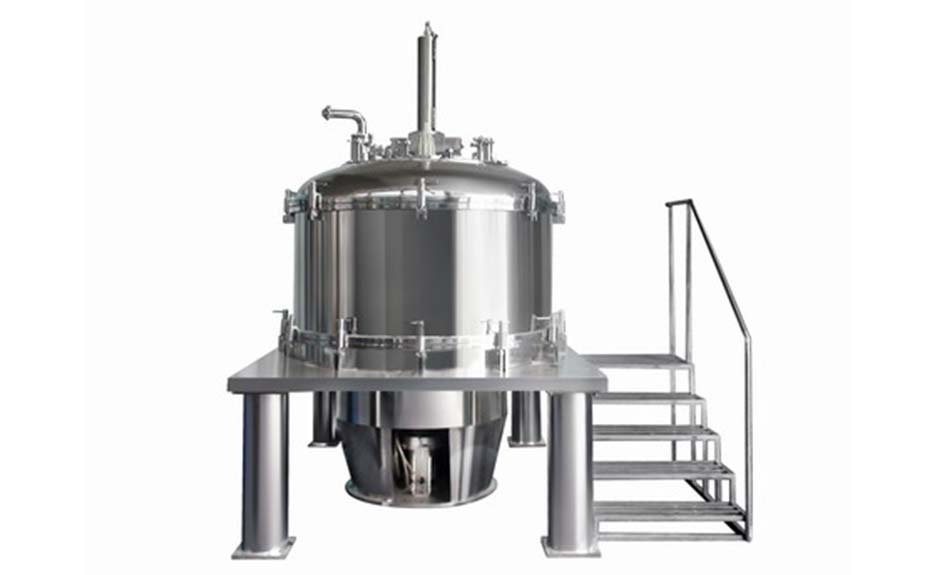
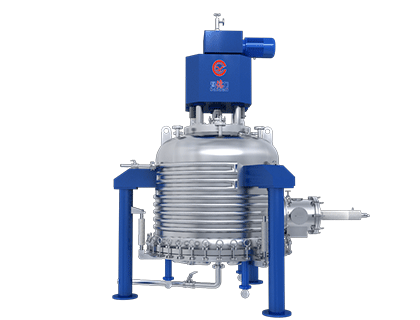
For applications where plant layout favors vertical equipment, Saideli's range of vertical centrifuges includes both scraper bottom-discharge and top-discharge configurations for chemical, pharmaceutical, food and other processing industries.
Discharge method determines how separated solids leave the basket and can affect automation, crystal damage, labor requirements and batch turnaround time.
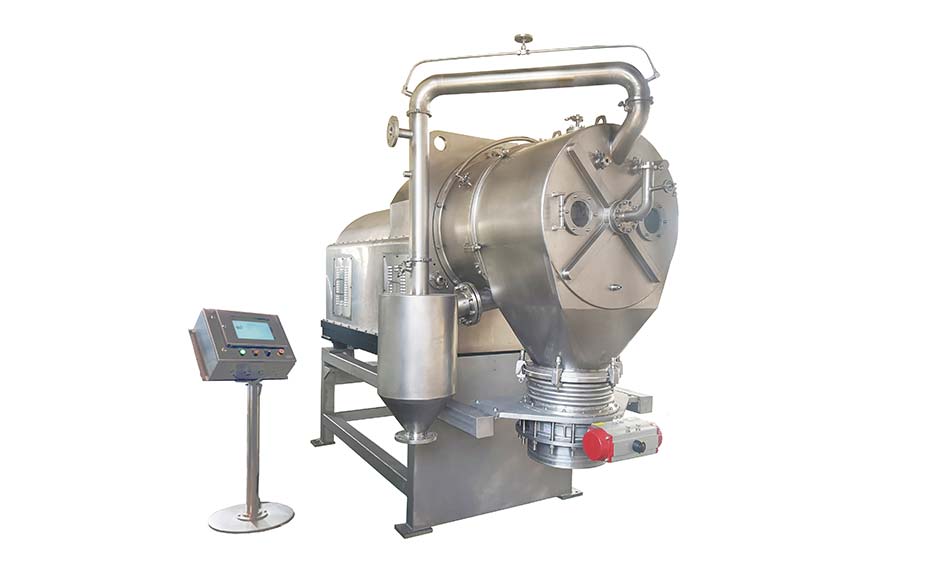
A scraper-type bottom discharge centrifuge removes cake mechanically and sends the solids through an opening beneath the basket. Saideli's LLGZ series uses a scraper together with a shaking-bag mechanism to help remove residual cake. Published models range from 800 to 1800 mm basket diameter with loading capacities from 100 to 1200 kg.
A top discharge centrifuge follows a different approach: operators or lifting mechanisms remove solids from the top. This can be attractive where gentle product recovery is important. Saideli's LB series lists basket diameters from 200 to 1500 mm and loading capacities from 3.5 to 800 kg.
Discharge configuration should therefore be selected together with basket type rather than treated as a separate purchasing decision.
The correct basket centrifuge should be selected from the suspension's filtration behavior, particle properties, desired product and discharge requirements.
Before final equipment selection, evaluate:
Particle size and distribution: determine whether particles can be retained efficiently by a filter medium.
Density difference: important when considering a non-perforated sedimenting basket.
Cake permeability: poor permeability can make filtration slow even under high centrifugal force.
Required cake washing: a perforated basket is usually easier to integrate with washing.
Product value: crystal-sensitive products may require gentler discharge.
Batch capacity and automation: determine whether manual top discharge or automatic scraper discharge is more appropriate.
Cleaning and containment: pharmaceutical or solvent applications may require closed housings, CIP and inert-gas capability.
Saideli manufactures several basket and scraper centrifuge configurations, so equipment selection can begin with actual material data rather than forcing every process into one centrifuge design.
Laboratory filtration tests or pilot trials are particularly useful when cake permeability or sedimentation behavior is uncertain.
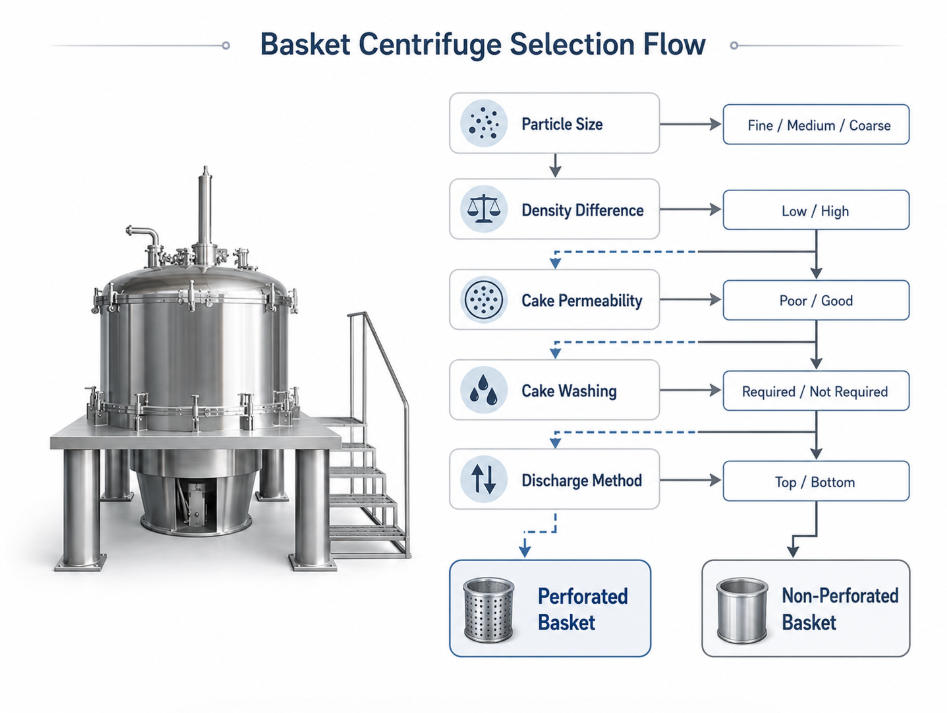
The perforated basket centrifuge vs non perforated basket centrifuge choice is fundamentally a decision between centrifugal filtration and centrifugal sedimentation.
A perforated basket is generally preferred when solids form a filterable cake that needs recovery, washing or dewatering. A non-perforated basket is more appropriate when particles can be separated effectively through density-driven settling.
For Saideli centrifuge selection, particle size, density difference, cake permeability, washing requirements and discharge method should all be defined before choosing the final machine configuration.
It is a centrifuge with a perforated rotating basket and filter medium that retains solids while liquid passes through.
It uses a solid basket wall and separates particles mainly through centrifugal sedimentation.
Usually yes. A suitable filter cloth or screen retains solids while allowing filtrate to leave the basket.
A perforated basket is generally better when crystals form a permeable filter cake.
Top discharge removes cake upward, while bottom discharge releases solids through the lower part of the centrifuge.
Provide particle size, density, solids concentration, filtration behavior, batch quantity, washing needs and required discharge method.